
-
CATEGORY ::
- All Seeds /
- All Pasture Seed /
- All Legumes
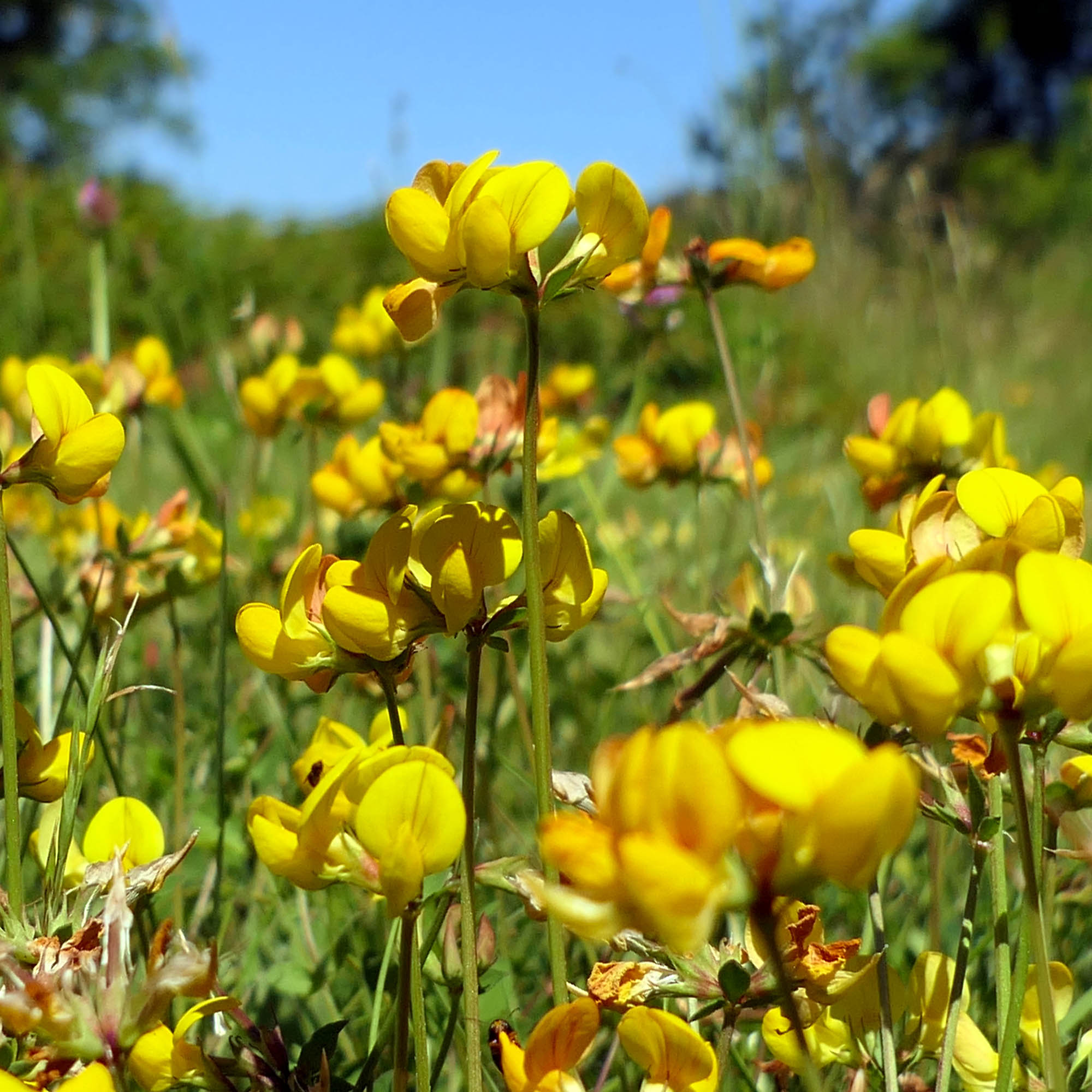
Birdsfoot Trefoil Legume Seed

LATIN NAME
Vicia villosa
SEASON
Annual
MOISTURE REQUIREMENTS
Moderate
CROP HEIGHT
24 - 36 inches
COLD TOLERANCE
Excellent
HEAT TOLERANCE
Fair
SHADE TOLERANCE
Good
DAYS TO MATURITY
80 - 100 days
WHEN TO PLANT
Late spring or 5 - 7 weeks before frost in fall
PLANT CHARACTERISTICS
Nitrogen fixator, high protein, acidid soil tolerance
LATIN NAME
Pisum sativum
SEASON
Annual
WHEN TO PLANT
Early spring to early fall
MOISTURE REQUIREMENTS
Moderate
CROP HEIGHT
24 - 36 inches
COLD TOLERANCE
Excellent
HEAT TOLERANCE
Poor - fair
SHADE TOLERANCE
Poor
DAYS TO MATURITY
60 - 180 days
PLANT CHARACTERISTICS
Nitrogen fixator, easy establishment
SEASON
Annual
USDA ZONES
3 - 9
HEIGHT
12 - 24 inches
BLOOM SEASON
Mid-summer to fall
BLOOM COLOR
Yellow
GROWTH RATE
Fast
ENVIRONMENT
Full sun
SOIL TYPE
Sand, loam, gravel, or clay, pH 5.6 - 7.3
FOLIAGE COLOR
Light green
LATIN NAME
Pisum sativum
SEASON
Annual
WHEN TO PLANT
After danger of frost in spring to fall
MOISTURE REQUIREMENTS
Moderate
CROP HEIGHT
36 - 48 inches
COLD TOLERANCE
Good
HEAT TOLERANCE
Good
SHADE TOLERANCE
Good
DAYS TO MATURITY
60 days
PLANT CHARACTERISTICS
Nitrogen fixator, wildlife attractant, fast growing
LATIN NAME
Vicia faba
SEASON
Annual
WHEN TO PLANT
After danger of frost
MOISTURE REQUIREMENTS
Moderate - high
CROP HEIGHT
48 inches
COLD TOLERANCE
Fair - good
HEAT TOLERANCE
Moderate
SHADE TOLERANCE
Fair - good
DAYS TO MATURITY
80 - 100 days
PLANT CHARACTERISTICS
Nitrogen fixator, high yields, high protein, high biomass
About...
Birdsfoot trefoil is a long-lived, deep-rooted perennial forage legume used for pasture, hay and silage and grows on many different soil types, from sandy loams to clays.MORE LEGUMES OPTIONS
Also known as "broadleaf birdsfoot trefoil," this long-lived, deep-rooted perennial forage legume is used for pasture, hay and silage. It grows on many different soil types, from sandy loams to clays. It accepts poorly-drained, droughty, infertile, acid or mildly alkaline soils. Most productive on fertile, well-drained soils with a pH of 6.2-6.5 or higher.
The nutritive value equals that of alfalfa, and there is no apparent problem from bloat, evern where pure stands are grazed.
Birdsfoot trefoil should be seeded with grasses for optimum forage production such as: timothy, smooth brome, orchardgrass, tall fescue, and perennial ryegrass. Also attracts deer, turkey, and rabbit.
Seeding Rate
5 to 8 lbs/acre.
More Information on Birdsfoot Trefoil
Species of Lotus are widely distributed throughout the world. Birdsfoot trefoil (Lotus corniculatus) is grown in the northeastern and north-central states and in the Pacific Northwest coastal and intermountain areas. It is suited to clay soils and areas that are too wet or too acid for alfalfa production.
Primary Use
Birdsfoot trefoil is a non-bloating legume that is suitable for use in permanent pastures or for use as a hay crop, either alone or sown in combination with grasses. When used for grazing, birdsfoot trefoil is used to best advantage in a rotational grazing system. when grown for hay on land that is suitable for alfalfa, birdsfoot will produce considerably less forage than alfalfa. For this reason, birdsfoot trefoil should be used only in areas that are not suitable for alfalfa production because of their acidity, poor drainage, or low fertility.
Establishment
Weak seedling vigor is the major problem encountered when establishing stands. Because birdsfoot trefoil has a relatively slow growth rate and small seed size, good seeing practices and weed control are essential. Seeding rates for various mixtures are indicated in the table. Seed should be covered slightly or planted inch deep. Planting seed above a band of fertilizer (band seeding) but not in contact with the fertilizer will enhance seedling vigor. Planting can take place in the early spring or late summer. Early spring planting is preferable because of ample soil moisture for germination and seedling development.
Fertility and pH Requirements
One of the major advantages of birdsfoot trefoil is its tolerance to low fertility and to low soil pH. However, maximum forage growth will occur on fertile soils with a pH of 6.0 to 6.2. A moderate application of phosphorus and sulfur at planting based on soil test data, will provide for good growth.
Management
Early spring or continuous grazing of birdsfoot trefoil will weaken and eliminate a stand. Rotational grazing should be used, allowing animals to graze when the first flowers appear. For use as pasture, this will allow two grazing periods on dryland pastures west of the Cascade Mountains or three grazing periods on irrigated land.
If used as a combination of hay and pasture, a hay crop can be taken at early bloom (June) and the regrowth grazed at first flower. On irrigated areas, two regrowths can be expected and can be used as hay or pasture. The third hay crop, or grazing period, can be expected in September. Regrowth can be grazed in October and November.
Birdsfoot trefoil is persistent and has a long life when managed properly.
Grazing
The most likely causes of loss of stand are continuous, hard grazing; competition through shading from too much grass and weeds; and excessively poor drainage such as standing water. Allowing some seed production during lenient grazing in summer will thicken the stand as the shattered seeds germinate quickly with irrigation or rain.
Diseases and Insect Pests
It is relatively free of insect and disease damage, and is very winter hardy once established.

Planting Directions
SOWING TEMPERATURE
60F
SEEDING RATE
15 - 50 lbs per acre
AVERAGE GERMINATION TIME
14 days
PLANTING DEPTH
1/2 - 1 1/2 inches
SOWING METHOD
Broadcast or drill
ENVIRONMENT
Full sun
USDA ZONES
3 - 9
ESTABLISHMENT RATE
Fast
Hairy Vetch (Vicia villosa) - Hairy vetch has better winter hardiness equates to more biomass. More biomass provides increased forage for livestock, more biomass for cover croppers, and increased weed suppression for all. Those desiring high nitrogen-fixing legumes for green manure, forage grazing, wildlife and pollinator attractants should find WinterKing an improved option over other legumes that lack cold tolerance.
As an annual legume, hairy vetch may need to be terminated either mechanically or chemically when followed by a row crop. Hairy vetch has shown potential to produce 150-200#N/acre, especially when allowed to reach maturity later in the season. This is beneficial for green manure as well as providing an extended high-protein source for grazing livestock throughout the full spring season.
Environmental preferences and Limitations
Hairy vetch tolerates cold well and is more winter-hardy than common vetch. If well-established in fall, it tolerates frozen soils, remaining dormant until spring. Warm spring temperatures bring rapid growth.
Hairy vetch seeds can be planted in soils with pH ranging from 4.9 to 8.2, but does best when pH is from 6.0 to 7.0. It can thrive in acid soils where clover and alfalfa do not grow well.
Hairy vetch does best on sandy or sandy loam soils but grows on most soil types if drainage is good. It tolerates some temporary flooding. Can withstand being flooded for long periods of time; however, stand quality and growth generally decline if there are long periods of flooding or saturated soils. It is somewhat shade-tolerant and more drought-resistant than the other vetches.
Inoculated Seed - We now offer hairy vetch seed which has been coated with an inoculant for better establishment. Nitrogen fixation is a one of the key values found in legumes and can only occur with the proper inoculation. Although many strains or Rhizobium may be present in the soil, all are not equally beneficial. With Nitro-Coat® each seed is inoculated with the correct Rhizobium strains and coated through a proven process that ensures a very high level of successful inoculation. A key to any successful establishment and early seed development is moisture. Nitro-Coat® is naturally water absorbent and helps attract soil moisture to the seed, getting your stand established quickly. This coating process which Outsidepride utilizes, assures that only the top-performing and crop-specific rhizobia will be applied to ensure your clovers reach maximum nodulation, stand establishment, and yield potential. With Nitro-Coat® each seed is inoculated with the correct Rhizobium strains and coated through a proven process that ensures a very high level of successful inoculation. The weight of the hairy vetch seeds will contain approximately 34% coating material that contains the inoculant and water holding material for better establishment and viability of the seed. There is no difference in the seeding rates between the coated and raw seed due to the increased germination and viability of the bulk hairy vetch seeds that are coated and inoculated. This coating material is not OMRI certified.
Planting Directions
SOWING TEMPERATURE
40F - 80F
SEEDING RATE
75 - 100 lbs per acre
AVERAGE GERMINATION TIME
10 - 21 days
PLANTING DEPTH
1 - 2 inches
SOWING METHOD
Broadcast or drill
ENVIRONMENT
Full sun
USDA ZONES
2 - 8
ESTABLISHMENT RATE
Moderate - fast
Austrian winter peas are a cool-season annual legume which can make a very attractive food plot on their own or as an addition to a seed mixture planted in the fall to attract deer. Easy to grow and quick to germinate, winter peas are very similar to garden peas and have the same nitrogen-fixing abilities which reduces the amount of fertilizer needed in your garden.
Austrian Winter Peas are also very good for cover crops and green manure crops, building tilth and adding organic matter and thus humus to the soil. Peas like well drained and fertile loam soils. Field peas are used as a winter annual in the South and as a spring annual in the North for soil improvement and for forage. Austrian winter peas are generally grown with a small grain for pasture, hay or silage. They can be used as a cover crop or green manure crop. This cover crop seed does not tolerate high water table or any substantial flooding.
These peas have a vine-like growth that can reach lengths of 3 to 5 feet when planted in fertile soil. Winter peas are highly nutritious and extremely digestible to deer. They carry a protein level between 20 and 30 percent. Both the seed, stem and leaves are browsed by deer. Foliage color is a pale green, and the plant produces pink blooms. Austrian winter peas have moderate drought tolerance but have good winter hardiness.
Seeding Rate
Vernal alfalfa has been the standard of the industry for many years. It exhibits good winter hardiness, has moderate re-growth after cutting, is fine stemmed and has dark green leaves. Vernal alfalfa is used mostly for hay production in medium rotation applications. It was developed by the University of Wisconsin and released in 1953.
Here are some of the outstanding features of Vernal alfalfa:
- Produces high yields even on fields where root rots are a problem
- Uniquely winterhardy, a full season variety with the winterhardiness of varieties adapted to the far north
- Wide spectrum pest resistance decreases yield fade in later stand years
- Very high yield potential, top performer in University yield trials
- Resists stem nematode problems common to lighter soils
- Very fast recovery and very good frequent cutting tolerance
Establishment
Use a soil test measure as a guide to check your pH and nutrient status several months before seeding alfalfa seeds. Apply lime and fertilizer as needed. Your pH levels should be 6.5-7.0. An ideal soil bed is moist, fertile and firm. Vernal prefers crumbly silt loam to sandy loam textures but alfalfa seeds will grow well on most deep, well-drained soils with adequate internal and surface drainage. Alfalfa will die if the soil is saturated for an extended period.
Plowing will result in a clean, firm seedbed, but you have to plant when the soil is not too dry or too wet. Plowing may bring rocks to the surface and the field would be more subject to soil erosion. Discing or harrowing requires less time than plowing/tilling, but may not rid the seedbed of weed seeds, diseased plant parts or herbicide residues.
No-till seeding of alfalfa seeds can be completed on a wider range of soil conditions and rocks are left below the surface and the field is far less susceptible to soil erosion. You also save time, fuel and power requirements.
Plant alfalfa seeds 1/4" to 1/2" deep on medium to heavy textured soils and plant at least 1/2" on sandy soils either in the spring or late summer-early fall.
Management
For maximum yields, it is important to have 20-30 plants per square foot during the seedling year for protection against weed competition. Do not harvest alfalfa seeded in late summer until the following spring. Allow new seedlings to start to bloom before the first harvest. Cut three-four times a year when stand is 25% flowered.
Seeding Rate
15 to 20 lbs/acre.
Inoculated Seed - Our Vernal alfalfa seed has been coated with an inoculant for better establishment. Nitrogen fixation is a one of the key values found in legumes and can only occur with the proper inoculation. Although many strains or Rhizobium may be present in the soil, all are not equally beneficial. With Nitro-Coat® each seed is inoculated with the correct Rhizobium strains and coated through a proven process that ensures a very high level of successful inoculation. A key to any successful establishment and early seed development is moisture. Nitro-Coat® is naturally water absorbent and helps attract soil moisture to the seed, getting your stand established quickly. This coating process which Outsidepride utilizes, assures that only the top-performing and crop-specific rhizobia will be applied to ensure your clovers reach maximum nodulation, stand establishment, and yield potential. With Nitro-Coat® each seed is inoculated with the correct Rhizobium strains and coated through a proven process that ensures a very high level of successful inoculation. The weight of the alfalfa seeds will contain approximately 34% coating material that contains the inoculant and water holding material for better establishment and viability of the seed. There is no difference in the seeding rates between the coated and raw seed due to the increased germination and viability of the bulk alfalfa seeds that are coated and inoculated. This coating material is not OMRI certified.